The Present Simple
Part 1: We Use It In the General Present!
We most often use the Present Simple for describing an action in the general present. That includes now, and also some time before and after now.
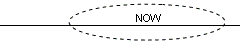
the general present
We can describe an action that is generally true.
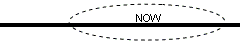
Birds fly.
(This is generally true.)
Babies drink milk.
(This is generally true.)
Mexicans speak Spanish.
(This is generally true.)
We usually do not use it to describe an action that is only true now. For that, we use the Present Continuous.
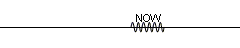
We also use the Present Simple to describe a state in the present.
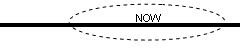
He's my brother.
(This is always true as long as he and I live.)
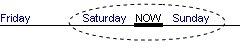
Today is Saturday.
(This is only true until today ends.)
These are things which may not always be true, but they are a state. We use the Present Simple to describe these states. Here are some more. Notice that they use the verb 'be' in the Present Simple.
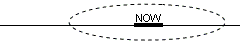
I'm sleepy.
(This is a state and is true now.)
We're very happy!
(This is a state and is true now.)
A monkey is on your head.
(This is a state--the state of the monkey--and is true now.)
Part 2: State Verbs
Some verbs are state verbs. They describe reality as states, and not actions. We usually use these verbs in the Present Simple. Some state verbs are:
have, like, love, want, need, know, mean, understand, believe, remember, see, feel, hear, smell
Here are some sentences and questions with state verbs:
She has green eyes.
I like green eyes.
We love chocolate.
He wants green eyes, but he needs an operation for that.
I know your grandmother.
What does that word mean? I don't understand.
I don't believe you!
Do you remember my name?
I see my hat, there in that tree.
Georgie feels sick today.
Sometimes we use state verbs to describe something that will be true for a short time, but we still use the Present Simple.
Do you hear that banjo music?
I smell food. Is it time for supper?
It can be a long state or a short one.
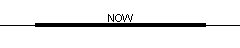
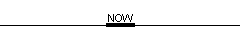
I feel good this week.
I feel good right now.
Be careful! Some of these verbs have special action verb meanings that are used in the Present Continuous:
Also, sometimes people use state verbs in the Present Continuous for a certain feeling.
You can read about these special cases later, when you read about the Present Continuous.
Part 3: Adverbs of Frequency
Adverbs are words that tell more about a verb or adjective. Adverbs of Frequency tell us how often something happens. When we tell how often something happens, we usually talk about time in general and use the Present Simple.
Dogs are always animals.
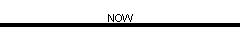
Dogs usually have tails.
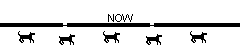
Dogs often chase cats.
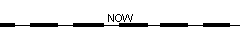
Sometimes, they play with cats.
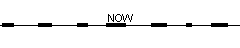
Dogs do not often wear clothing.
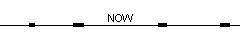
Dogs rarely drive cars.
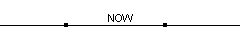
Dogs never speak perfect Chinese.
Part 4: Planned Actions
Sometimes people use the Present Simple to describe a planned action in the future. This is a special use, and it's logical because the plan exists in the general present.
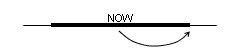
I leave for Spain tomorrow at noon.
Later this week I cook dinner for my wife's family.
Be careful! People more commonly use the Present Continuous or 'going to' for this situation.
Part 5: 'If' Clauses and Time Clauses
There are other interesting exceptions.
When we say "if" about the possible future, we use the Present Simple.
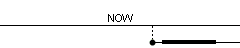
If you eat that mushroom, you'll feel ill.
We also do this with unless, which means if not.
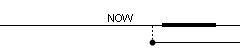
You'll be sick unless you take this medicine.
We also use the Present Simple with some time clauses.
Time clauses tell us about another time using words like
before, after, when, while, until, as, as soon as
It's logical to use the Present Simple in a time clause in the present.
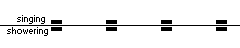
I always sing while I take a shower.
These other examples are also about the present.
As I get older, I get more interesting.
I eat breakfast before I leave the house.
But if a time clause is about the future, we usually use the Present Simple. This is not very logical, but…well, English is a crazy language.
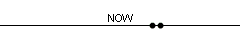
When she sees him, she'll kiss him.
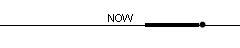
I'll wait until you arrive.
More Tense Discussions:
The Present Continuous - The Present Perfect - The Present Perfect Continuous - The Past Perfect