The Past Perfect
Part 1: Introduction to the Past Perfect and How to Make It
The Past Perfect is made with a form of 'had' + the past participle form of the verb. This is just like the Present Perfect, except with 'had' in place of 'have' or 'has'. We sometimes call it the Past Perfect Simple, because there is also the Past Perfect Continuous. Here, we'll just call it the Past Perfect.
While we usually use the Present Perfect to talk about a present situation as a result of a past action, we usually use the Past Perfect to talk about a past situation as a result of an earlier past action.
Like the Present Perfect, we usually use the Past Perfect for one these three reasons:
1) Change in Situation
I felt bad because I had eaten spiders for breakfast.
2) Life Experience
She told me that she had never eaten spiders.
3) Up to Then
(up to a time in the past)
By the end of the meal, the baby had eaten three spiders.
It's a similar to the Present Perfect, but the result of the action is in the past, not the present. Also, the action causing the effect is in an earlier past. Let's look at examples for each of these three reasons.
Part 2: Reason 1, Change in Situation
If an action changed the situation in the past, we can describe the past effect in a later past time using the Past Perfect.
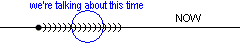
I asked her whether she had enjoyed the music.
(I asked her whether she had a good feeling as a result of the music.)
Morty had shaven his head.
(His hair was gone.)
My sister called me and said that she'd gotten married.
(When she called, she had a new husband.)
I had forgotten to wear my pants!
(Everyone laughed at me because I didn't have any pants on.)
We can use the Past Perfect in this way to talk about something that happened before the time we're talking about.
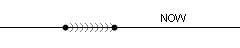
I met her in the same place where we had met the day before.
Later that day, I ate the lunch that I had prepared.
This is like Change in Situation without a really changed situation, and it's just a way to tell about an earlier past action. In English, we can't say "I bought him lunch because he boughted me lunch." to describe the past of the past. Instead, we use the Past Perfect:
I bought him lunch because he had bought me lunch.
Part 3: Reason 2, Life Experience
We use the Present Perfect to describe a Life Experience, but we use the Past Perfect to tell about a someone's Life Experience at a time in the past.
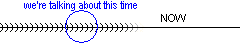
Before my trip to Paris, I had never been to France.
(The trip was my first time in France. Before that, I had no experience of visiting France.)
I saw the movie because I had read the book.
(He knows the story.)
She told me that she had met me before.
(She had a memory of me.)
When asking about someone's entire past up to a particular time, use the Past Perfect.
Also, be careful only to use the Past Perfect when you're referring to an earlier past time.
Let's return to our Present Perfect example about kissing Mary, but let's move it to the past so that we can use the Past Perfect when we mention a past action that is earlier than the main time that we're thinking about:
"Yesterday I kissed Mary!"
"Had you ever kissed Mary before that?"
"Yes, I had."
"Really? When had you kissed her?"
"I'd kissed her on Thursday, and I'd kissed her last week, too."
"I've never kissed her! Before yesterday, how many times in your life had you kissed her?"
"I'd kissed her twenty times. Now, I've kissed her twenty-one."
"Really? I talked to her today and she told me that she'd never kissed anyone."
"Um..."
Notice that we can mention when the earlier action occurred. This is an important difference between the Present Perfect and the Past Perfect.
Part 4: Reason 3, Up to Then
We use the Past Perfect to describe actions that happened up to the time we're talking about. (This is like our use of Up to Now for the Present Perfect, but for actions leading up to the past time that we're talking about.)
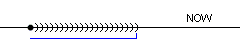
When we finally stopped him, the dog had eaten five cookies.
(When we stopped the dog, a total of five cookies were gone..)
He'd lived in Rome all his life.
(He lived in Rome as a baby, as a boy, as a man—all of his life, up to then.)
Was she angry because you still hadn't done what she'd asked?
(She asked you to do something, and you never did it in the time up to then. Was she angry because of that?)
Part 5: Combinations of These 3 Reasons
Like with the Present Perfect, it's possible to combine these three reasons for the Past Perfect.
Change in Situation and Life Experience
He'd studied Russian a lot, so he spoke Russian very well.
Change in Situation and Up to Then
Tom was happy because he'd eaten fifteen pizzas.
Life Experience and Up to Then
Until that night when Uncle Jack started dancing, our dog had never bitten anyone.
Change in Situation, Life Experience and Up to Then
I once met an old man who had lost twenty teeth and ate only soup.
During his life, he had lost a total of thirty teeth. As a result, when I met him he ate only soup.
Part 6: Using the Past Perfect for Hypothetical Pasts
When we talk about a past that isn't real, but just an idea or possibility, we usually use the Past Perfect.
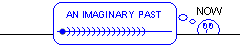
Imagine that you had never been born!
(You were born, but imagine that you had not been.)
I wish that I had gone to China last year.
(Last year I didn't go to China, but I wish that I had.)
This is very useful when making a conditional statement about the past. We use the Past Perfect to make the Third Conditional. (Conditionals are a special subject that you may want to study separately.)
If I'd married Sally, I never would have met Minnie.
If I hadn't met Minnie, she wouldn't have broken my heart.
Part 8: Using the Past Perfect in Reported Speech
The Past Perfect is also very useful in reported speech. In reported speech, we repeat what someone has told us at a time in the past. If that person has told us about the past, then the past is earlier than they told us about it, so we use the Past Perfect.
We use the Past Perfect for reported speech when we're reporting the Past Simple and the Present Perfect. We use it for both of them because it's the only way we can move these two tenses further into the past!
| Speech | Reported Speech |
| Bill: "I went skiing last night." | Bill said that he'd gone skiing the night before. |
| Marty: "I've eaten too much." | Marty said that he'd eaten too much. |
| Clem: "We've lived here all our lives." | Clem told me that they'd lived there all their lives. |
| Annette: "Have you ever seen a ghost?" | Annette asked whether I'd ever seen a ghost. |
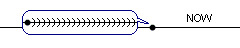
Part 9: The Past Perfect Continuous
Ah, yes! There is also the Past Perfect Continuous, which has a meaning like the Present Perfect Continuous, but, like the Past Perfect, it refers to a resulting situation in the past. When you feel comfortable using the Past Perfect Simple, you can compare it to the Past Perfect Continuous.
More Tense Discussions:
The Present Simple - The Present Continuous - The Present Perfect - The Present Perfect Continuous