The Present Perfect
Part 1: Making the Present Perfect
The Present Perfect is made with a form of 'have' + the past participle form of the verb. The past participle is sometimes called the third form of the verb, because many people learn verbs in their three forms, such as "drink / drank / drunk". The past participle of "drink" is "drunk". (My brother is also drunk right now, but that's an adjective, not a past participle. Don't let it confuse you.)
We normally use the Present Perfect to describe the present situation as the result of a past action. Remember: We're talking about the present, which was affected by the action or is related to the action. We're not referring directly to the past action! (For that, we use a past tense.)
We usually use the Present Perfect for one of these three reasons:
1) Change in Situation
I've eaten spiders, and now I feel funny.
2) Life Experience
I've eaten spiders, but I've never eaten sushi.
3) Up to Now
I've eaten spiders three times today.
Part 2: Reason 1, Change in Situation
The result of an action can be described using the Present Perfect. This describes the situation created by the action.

I've bought a new car.
(Now I'm happy and I can drive.)
I've just seen a ghost!
(I'm afraid!.)
Have heard the news?
(Do you know the news yet?)
Harold has cut his finger.
(Now he's bleeding.)
The action that changes the situation is often recent, but it isn't always recent.
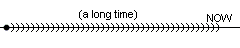
My children have grown up.
(Now they're older.)
Life is more interesting these days, because we have discovered nuclear war.
(Now we know how to kill a lot of people quickly.)
If we tell when the action happened, we almost never use the Present Perfect. For that, we use the Past Simple. We almost always use the Past Simple if the action happened in a completed, past time. It is a separate time from the present.

It is okay to use the Present Perfect if the action happened in a time that isn't yet over. You can read more about that below in Up to Now.
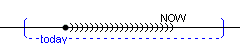
I feel ill because I've eaten two spiders today.
Here, it feels like reason #3, Up to Now.
Part 3: Reason 2, Life Experience
It's common to talk about past experiences using the Present Perfect. Notice that when we do, we are telling about the person we are now as a result of the experiences.
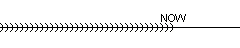
I've driven a Porsche.
(I know what it feels like.)
He's read that book.
(He knows the story.)
Have you ever drunk blue wine?
(Do you know what blue wine tastes like?)
I've been to Rome three times.
(I know what Rome is like, because of my three visits there.)
Have you ever visited Tokyo?
(Do you have a knowledge of Tokyo? Are there any visits to Tokyo in your past?)
It's like we "have" this experience or these memories in our brain now.
When asking about someone's entire past, use the Present Perfect.
Also, the reverse is true. We usually don't use the Present Perfect for a life experience if we say when it happened. In that case, we aren't talking about the person we are now (as a result). We're talking about what we did then.
It is common to use both the Present Perfect and the Past Simple for the same verb. In a conversation like this one, we can talk about the life experience of the action and the action in the past:
"Have you ever kissed Mary?"
"Yes, I have."
"Really? When did you kiss her?"
"I kissed her on Thursday, and I kissed her last week, too."
"I've never kissed her! How many times have you kissed her in your life?"
"I've kissed her twenty times in my life."
"Really? When did you first kiss her?"
"I first kissed her about two years ago.."
"And did you kiss her only once that year?"
"No, I kissed her seven times that year."
Notice that when we speak of specific actions, we use the Past Simple. This is even true when we don't know exactly when the time was, as in "When did you first kiss her?".
Part 4: Reason 3, Up to Now
When we're talking about a time that is still continuing, we often use the Present Perfect for an "up to now" feeling.

I've eaten twice today..
(That is the current total, and today isn't over yet.)
We've danced all day.
(So far it's true, and today isn't over yet.)
Have you taken a bath yet?
(You were dirty earlier. Are you clean now, or are you still dirty?)
Notice the difference between these two examples. The information is similar, but there is an important difference. The first is Up to Now, but the second is talking about a finished time.
This morning I've had three cups of coffee.
(It sounds like it is still the morning.)
This morning I had three cups of coffee.
(It sounds like it is later--during the same day, but after the morning is over.)
Part 5: Words Often Used with the Present Perfect
The underlined words in these examples are often used with the Present Perfect.
Change in Situation
Someone has just turned out the lights!
(It's dark!)
I've finally bought a new car!
(I have a new car, after all this time!)
She's already left!
(She is gone! That was fast.)
Life Experience
Have you ever seen a unicorn?
(Do you have a memory of seeing a unicorn?)
I've never seen a unicorn.
(There is no memory of seeing a unicorn in my past.)
Up to Now
Have you called Joey yet and told him your answer?
(Is Joey still waiting to hear the answer from you?)
No, I still haven't called him!
Joey is still waiting and he still doesn't know!)
(Note: The words are listed above with reasons that are common for them, but they are not only used for those reasons.)
Part 6: Combinations of these 3 Reasons
Remember that in general, the Present Perfect describes a present situation that is the result of some past action. We have 3 common reasons for doing this. Sometimes we use the Present Perfect for 2 or 3 of the reasons together!
Change in Situation and Life Experience
She speaks French very well now because she has lived in France.
Change in Situation and Up to Now
I'm tired because I've worked all day.
Life Experience and Up to Now
I've been to Poland three times this year.
(The person is describing their life experiences during this year, and this year is not yet over.)
Change in Situation, Life Experience, and Up to Now
He's traveled the world for years.
(This can be about many things all together. Because he has traveled the world for years, he is now wise, he has a lot of experiences in his personal past, and he has traveled from some time in the past up to now.)
Part 7: A Special Exception (Using the Past Simple When the Time Described isn't Over Yet)
If an event is an incomplete time, we can use the Past Simple to describe it if is it over and we've not describing it's effect.
I had mushrooms for breakfast today.
(Today is not over yet, but we know that the time for breakfast is over. Also, we're talking only about the action, and not its effect.)
Or:
I saw your brother on the bus today.
(Today is not over yet, but we know that the time when I was riding the busis over. Also, we're talking only about the action, and not a feeling or memory that I have now because I saw your brother.)
But:
I'm crying because I've seen your brother today.
(Change in Situation)
I haven't seen your brother today.
(from this morning up to now)
I've seen your brother twice today.
(the total times that I've seen him up to now)
Part 8: The Present Perfect Continuous
Sometimes we use the Present Perfect Continuous when we notice an effect from a recent action, when we want the past action to sound more active, and for other reasons. You can read about that after you have thought about the Present Perfect a lot!
More Tense Discussions:
The Present Simple - The Present Continuous - The Present Perfect Continuous - The Past Perfect