The Present Continuous
Part 1: Making the Present Continuous
The Present Continuous is made with a form of 'be' + the ing form of the verb.
We're eating pizza.
Are you talking to me on your mobile phone?
Look! I'm flying!
We can call the ing form the Present Participle of the verb.
Part 2: We Use It to Describe an Action Right Now.
We most often use the Present Continuous for describing an action that's happening at the time when we're speaking/writing.
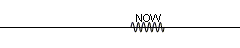
I'm sitting at the computer.
(This is true right now.)
The telephone is ringing! Answer it!
(This is true right now.)
Right now I'm eating some ice cream.
(This is true right now.)
Sometimes it can be something that started before now and will be finished after now, if we understand that it is still unfinished.
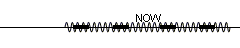
This weekend I'm reading a book.
(I read it yesterday and last night, and I'll read it tonight and tomorrow.)
I'm looking for a new job.
(I looked today and before today, and later I'll look again.)
We usually do not use it to describe an action that is generally true in the present, or to describe states. For those, we use the Present Simple.
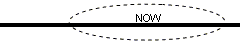
It is possible to use the Present Simple and the Present Continuous with the same information, but for a different meaning.

Many Italians eat spaghetti.
(This is generally true. Spaghetti is a popular food in Italy.)
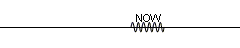
Many Italians are eating spaghetti.
(This is true right now. I'm at a restaurant and I see them!)
Part 3: More Details
We usually use the Present Continuous for something happening right now, or that is not yet finished.
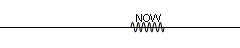
I'm eating a cookie.
(This is true right now.)
We can also use the Present Continuous for an action if:
We want the action to sound very active.
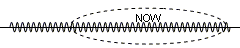
He's always working on his car!
(This is generally true, so we can say "He always works on his car.", but the Present Continuous sounds more active than usual.)
The action repeats.
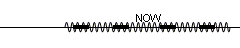
This year it's snowing a lot.
(This has happened many times and may continue.)
The action is temporary.
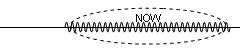
This week I'm living at my friend's house.
(This is true at the moment, but usually it's not true.)
Part 4: State Verbs
Some verbs are state verbs. They describe reality as states, and not actions. We usually use these verbs in the Present Simple. We usually do not use them in the Present Continuous.
Some state verbs are:
have, like, love, want, need, know, mean, understand, believe, remember, see, feel, hear, smell
But many words that are used as state verbs are sometimes used to describe actions. They are not state verbs then.
| Usual State Verb Example | Special Action Verb Meaning | |
| have | I have some money. | to eat; to give birth |
| see | I see my friends over there. | to perceive or hallucinate; to visit; to date or go out with |
| feel | I feel tired. | to put your hand on something because you want to learn, for example, its texture or temperature |
| taste | I taste salt in my tea! | to put your tongue on something because you want to learn its flavor |
| smell | I smell smoke. Is there a fire? | to inhale the air because you want to learn its scent |
Here are some examples of these words used in the Present Continuous:
We're having a pizza. Are you hungry?
=
We're eating a pizza.
Doctor, come quickly! My wife is having a baby!
=
My wife is giving birth to a baby.
My head hurts and I'm seeing stars.
=
I'm not well. I can see stars right now, and usually I don't.
My sister is seeing a dentist.
=
My sister is visiting a dentist.
Please stop feeling my head.
=
Please stop touching my head.
He is tasting his coffee to see whether it is sweet enough.
=
He is drinking his coffee to test its flavor.
Why is your dog smelling my feet?
=
Why is your dog sniffing my feet?
Part 5: Planned Actions
Sometimes we use the Present Continuous to describe a planned action in the future.
There are two ways to do this.
We can use 'going to' + a verb if something will happen because of a plan, or a situation that will probably result in the verb. The 'going to' part is in the Present Continuous.
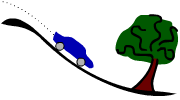
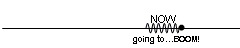
Oh, no! That car is going to hit that tree!
(We can see the car moving toward the tree!)
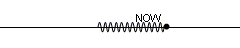
I'm going to buy a new boat soon.
(It's a plan.)
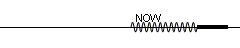
It's going to rain today.
(Perhaps it is cloudy, or the television predicted rain.)
Sometimes we just use the Present Continuous (without 'going to') for future plans.
When we do this, it is usually clear that we're talking about the future because of the context.
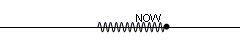
I'm leaving for Spain tomorrow at noon.
(It's a plan.)
Later this week I'm cooking dinner for my wife's family.
(It's a plan.)
Be careful! People sometimes use the Present Simple for plans, but it's not as common.
More Tense Discussions:
The Present Simple - The Present Perfect - The Present Perfect Continuous - The Past Perfect