Phrasal Verb Games
| Phrasal Verb Games | |||||||||
|
|||||||||
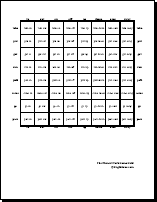
| 5 in a Row - Students place their gamepieces on squares in turn, trying to make a vertical, horizontal, or diagonal line of five before their opponent does. Before placing a gamepiece onto a square, a student must correctly use the square's phrasal verb in a sentence (or command or question). If they don't make a correct sentence, then they don't get to place a gamepiece that turn. 2 to 4 can play. If 4 people play, you may want to simplify the game to "4 in a Row". If you don't have enough gamepieces, students can write initials, symbols, or colored marks instead. Note that in this game phrasal verbs are not repeated if correctly answered once. | |||||||||
Chinese Checkers - 2 to 4 students begin the game with 4 gamepieces apiece, each gamepiece on one of the 4 squares near a corner (for example, take in, take out, put in, and put out). Every turn, the student may move one gamepiece one square in any direction, with the goal of filling the 4 squares of the opposite corner. Of course, before moving to a square they must first use the square's phrasal verb correctly in a sentence. If a gamepiece (their own, or an opponent's) is next to one of theirs when their turn starts, they may 'jump' their piece over it if there is a square behind the second piece, in the same direction. One may jump a second, third, and more times if, after each jump, there's another piece and an empty square behind it, and it's possible to change direction while jumping--but you can't jump after moving a space, and you can't move a space after jumping; on a turn, you can either move one space, or jump one or more times. When jumping, the student must use a square's phrasal verb correctly before jumping there, or else their turn stops where they are. The winner is the first to land all of their pieces in the 4 squares by the opposite corner. One aspect to keep in mind about this game is that players are motivated to move from one corner to another, which may limit which squares they use. You may want to repeat the game, asking every player to rotate their starting corner 90 degrees the second time. There is another variant, in which students begin with only 3 gamepieces on the edge squares near a corner (for example, take in, take out, and put in) and try to move each gamepiece to one of the 3 edge squares in each of the other 3 corners, using a bigger variety of phrasal verbs. This second variant is more interesting if played by 4 players, leading to more gamepiece interaction. |
|||||||||
| Landgrab - 2 to 4 students take turns drawing a line from the center of any square to the center of a square adjacent to it (up, down, left, or right). Before drawing a line, students must correctly use the squares' phrasal verbs in a sentence. If drawing a line from get over to run over, the sentence may be I'll never get over the time that I ran my teacher over with a tractor.. Whenever someone's line completes a single square (a 1 by 1 square, not a larger one), that square belongs to them and the person marks it with their initials, or any symbol that they choose to represent them (such as a flower, a smiley face, or a wireframe truncated hypercube). The game continues until a time limit, or until no more lines can be drawn. The player who has captured the most squares is the winner. This game allows many phrasal verbs to be used multiple times. | |||||||||
| Storytelling - Put the students into pairs or small groups and tell them that they're going to create a story together. You can let them decide on the story's topic, or you can assign one, perhaps related to recent vocabulary. They then randomly choose a square, and the first student begins the story and draws a dot on the square, creating a sentence using the corresponding phrasal verb. The next student draws a line from that square to the next, creating another sentence, and so on. Encourage the students to use as many of the phrasal verbs as they can. After some time, ask them to stop and retrace the lines, trying to remember their stories. Additionally, groups can share their stories with the class, and students can take home a copy of the grid with their lines on it and retell the story as a writing assignment. Among this game's strengths is the repetition of the story from memory using the phrasal verbs as cues, which reinforces the phrasal verbs' meanings. | |||||||||
| Battleship - Pair students and give each a grid, telling them to keep it hidden from their partner. At this point, it's a good idea to draw a grid on the board for an example, or you can use a grid yourself if the students can see it clearly. Draw a rectangle by outlining a row or column of 4 squares somewhere on your grid, and explain that it's a warship. Then draw two rectangles made from 3 squares, and three made from 2. At this point, announce that they will be playing a sea battle game where they will try to find and destroy all of their partner's ships. Demonstrate how a turn of play will go: A student will ask their opponent a question, correctly using a phrasal verb. (If the question is incorrect, the opponent may correct them. It's not necessary that a person lose their turn when they make a mistake, though you can change this rule.) The opponent must then answer the question in an interesting way, and if the corresponding square was occupied by one of their ships, they must then say "BOOM!". Demonstrate a few rounds, inviting students to sink your ships (which should be easy if they can see where they are). Now the students draw their ships wherever they want on the phrasal verb squares, and each pair plays the game until a time limit or until all of one player's ships have been sunk. Note that if you want, you can change the theme from warships to insects (you're trying to find a worm, two beetles, and three ladybugs) or whatever other theme you want. This game uses each phrasal verb no more than twice. | |||||||||
| Footprints - Each player receives a colored marker. (If you don't have markers for everybody, students can simply draw initials or symbols.) The first player then chooses any square and makes a sentence using its phrasal verb. If it's acceptable, the player chooses an adjacent square (in any direction) and makes a second, preferably continuing the idea of the previous sentence. They should continue up to 5 sentences, or until they fail to make an acceptable sentence. Then it's the next player's turn. Play continues until a time limit, or until all squares have been covered at least once. The number of phrasal verbs reused depends on how many students mark squares after their opponent. This is possible, since the rules require that adjacent squares be used, so a student may need to cross an opponent's path to reach an unmarked square. This game can be played by individual students, and also by competing teams, rotating among team members to create the sentences in a turn. This latter approach can be used as a activity for the class as a whole. | |||||||||
| That's not all. Be creative and you may discover new possibilities for this grid. You may also think over other areas of teaching that you can use these kinds games to practice. For example, you can create a similar grid to use with tenses, irregular verbs, expressions of quantity, indirect questions, modal verbs, vocabulary words, and more. Have fun! | |||||||||
© Englicious.com |
|||||||||