The Past Simple
Part 1: Making the Past Simple
To make the Past Simple, we use the past form of the verb. For example:
We saw your dog on television yesterday.
I drank too much oil.
When forming a negative or a question, we usually use did + the bare infinitive with normal verbs, like play, eat, do (if used as an active verb and not as an auxiliary) and tickle. Notice that we can shorten did not to didn't.
Did you eat my pencil?
No, I didn't eat your pencil.
That is usually true, but not if the question starts with the subject:
Who put my hat in the refrigerator last night?
We don't use did in questions and negatives with a few special verbs. These include be (was/were) and can (could).
Were you afraid when the giant spider came into the room? No, I wasn't.
She can't remember where she left her husband.
If you need help remembering the past form of irregular verbs, you can visit our Elementary, Intermediate, and Advanced irregular verb lists.
Part 2: Using the Past Simple
In general, the Past Simple describes a past action, but it can be something that happened only one time, or something that happened many times. It can be something that happened quickly, or something that happened for a long time. We usually understand the meaning because of the verb and the context.
Look at these two examples. One is about a simple action in the past. The other is about an action that happened more than once in the past.

Yesterday I rode a purple horse.

When I was a boy, I rode a motorcycle.
In this way, we can use the Past Simple to describe a state or action that happened many times or for a long time in the past. Here are more examples:
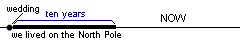
After our wedding, we lived on the North Pole for ten years.
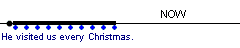
My father visited us there every Christmas.
Notice also that the context ("after our wedding", "for two years", "every Christmas") helps us to understand when, how long, and how often the verb happened. Also, since the verb "live" usually lasts a long time (we usually live somewhere for several days or more), it also helps us to understand that the action wasn't a short one.
Part 3: The Past Simple and Hypothetical Actions
When we talk about something that we are imagining, but that maybe isn't true, we often speak hypothetically. To show that something is hypothetical, we often describe it in a way that sounds like the Past Simple.
Try to imagine that you had three heads. (It's only an idea that we are imagining.)
There is one important difference. Instead of was we use were.
I wish that he were Chinese, and that I were Chinese, too.
Some people use was here anyway (as in "I wish that he was Chinese..."), maybe because they don't understand the rules of English very well. Languages can change with time and maybe one day everyone will say "I was" and "he was" when speaking hypothetically. (I hope that I will either be dead or speaking another language if that day comes.)
This is an important idea in the Second Conditional, a form that we use to talk about a hypothetical situation and its possible effect. The Second Conditional is generally made from a hypothetical if clause and a result clause that uses would (showing a hypothetical result with a past form of will).
If you were only five centimeters tall, where would you sleep?
If I were only five centimeters tall, I would sleep in a warm glove.
There are many kinds of conditional sentences and questions, and we won't talk about all of them here. The Second Conditional is useful for describing something that we're imagining. Just remember to use the Present Simple for the conditional clause.
Part 4: Other Tenses for Describing the Past
There are other tenses for describing the past, and they're useful for telling stories. After you are comfortable using the Past Simple, try learning about the Past Continuous, the Past Perfect, and the Past Perfect Continuous.