The Future Simple
Part 1: Making the Future Simple
To make the Future Simple, we need a form of will + a verb. For example:
The planet Mars will explode next week.
Tomorrow I'll sell my grandfather to my friend.
We use the word will and we don't need a form of do for the question and negative forms.
Will you be alive tonight?
I won't be able to visit the Moon this summer.
Notice that will can be shortened to 'll, and will not can be shortened to won't.
Part 2: Using the Future Simple
We usually use the Future Simple for one of these reasons:
1) to describe the future in a way that isn't connected to the present
In twenty years, all the people in Russia will be vampires.
I won't be home tonight. I'll be in jail.
2) to describe a spontaneous decision (a decision that you've just made), with "I will"
I know what I'll give her for her birthday. I'll bake her a chocolate cake with worms in it!
Zombies!! I'll call the church and ask them for help.
3) to offer or suggest something, with "I will"
Are you hungry? I'll give you some plastic peanuts.
If you need to go to China, I'll let you borrow my horse.
...or possibly, to threaten
You've broken my leg!! I'll kill you!!
All of these reasons describe a future action in a simple way.

Part 3: Other Basic Future Forms
The Future Simple is only one possible way to describe future actions, and there are other ways. Let's compare them with the Future Simple here, to be clear.
"going to" - to describe an existing plan, or to describe a future action that we think will happen because of something that is true now

I'm going to buy some new hands. (That's my plan. I've already decided to do it.)
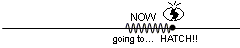
Look! The dinosaur eggs are going to hatch! (We can see that they are cracking and moving.)
You can compare the two sentences above with these two, which use the Future Simple:
I'll buy some new hands. (With the Future Simple, it sounds like a new decision--not a plan, or maybe it's an offer to buy some new hands for somebody who has old hands.)
The dinosaur eggs will hatch soon. (We think that they'll hatch soon, but we aren't saying that something now is leading to that future action.)
Sometimes people prefer not to use "going to" for certain verbs--usually 'go', 'come', 'see' (visit someone), 'have' (in an active form) and 'meet'. Instead, they prefer to use the Present Continuous with those verbs in the future.
the Present Continuous (used in a special way for the future) - to describe an existing plan, especially an arrangement that people have agreed on
She can't go to the dance tomorrow because she's working at the insect zoo.
We usually know from the context that we're talking about the future. In this example , we know that the dance is tomorrow, so "she's working" is about the future, not the present.
Imagine that you called your friend and he said: "I'm eating a monkey tonight." Without any context, you wouldn't know whether he means "I have a plan to eat a monkey later tonight." or "Right now, I'm sitting at a table and holding a piece of delicious monkey meat on a fork.". The context is important!
the Present Simple (used in a special way for the future) - to describe an existing plan, especially a firm arrangement like a timetable for a plane, train, or bus
Kiss me quickly! My bus leaves in ten seconds! (That is the fixed time when the bus will leave today.)
Igor the dancing skeleton goes onstage in five minutes. (The part of the show with Igor will begin in five minutes, as planned.)
This is not as common as the other Future Forms, but people do use it.
Part 4: Special Uses of the Future Simple Form
There are also some uses of will + verb that are a little different. These rules are special and you don't need to know them to understand basic English!
to show willingness, that someone wants to do something - common when asking someone to do something
I hope that you'll help me. (This can be about the future, or it can mean "I hope that you want to help me.".)
Will you hand me that machine gun, please?
To be more polite, we can ask using "would", which sounds hypothetical. (In English we sometimes try to sound hypothetical to be polite, because it's less direct.)
Would you hand me that machine gun, please?
to express a tendency
On weekends I sleep with my pillow over my head, because sometimes my brother will come home and play his trumpet in the middle of the night. (My brother tends to play his trumpet at night on weekends.)
She'll often get angry at people for throwing snakes at her during lunch. (This is similar to the will part of a conditional statement, but here we're describing something that she tends to do on more than one occasion, so it's a little different.)
with emphasis, to show that someone does something annoying or is very determined to do it (This is more common in British English.)
My little brother will stick his fingers in my mouth when I ask him not to.
to command someone to do something
Young man, you will take that alligator out of the bathtub immediately, and you won't bring it back into this house again!
Part 5: A Special Rule (Time Clauses and Conditional Clauses)
Time clauses and conditional clauses may tell us a time or condition when an action will happen. When we use one of these clauses to describe the future, we usually don't use the Future Simple (will + verb). Instead, we usually use the Present Simple.
Here are some examples of clauses. Imagine that the person saying these sentences is a man who is eating supper, and he wants his wife to give him chocolate, but he hasn't eaten his vegetables yet. Notice that we use the Present Simple in the clause about the future, and in the rest of the sentence we use the Future Simple to describe the future.
| time clause | example |
| when | When I eat my vegetables, she will give me some chocolate. |
| before | Before she gives me the chocolate, I will eat my vegetables. |
| after | After I eat my vegetables, I will eat the chocolate. |
| while | While I eat my vegetables, I will think about the chocolate. |
| as | As I eat my vegetables, I will think about the chocolate. |
| as soon as | As soon as I eat my vegetables, she'll give me the chocolate. |
| until | I won't be happy until I eat the chocolate. |
| conditional clause | example |
| if | If I eat my vegetables, she'll give me the chocolate. |
| unless | She won't give me the chocolate unless I eat all of my vegetables. |
Yes, that's right. We used the Present Simple in these sentences to talk about the future because the action we described was in a time clause or a conditional clause. It is also important to remember that a conditional clause is sometimes at the beginning of the sentence, but not always. Look for the word (when, before, if, etc.) that begins the clause.
Although we usually don't use will in time and conditionals, we sometimes do use will for one of the special cases, as described above. For example, we can use will in a time clause or a conditional clause to talk about willingness (that someone wants to do something). This isn't very common, but sometimes it is used.
If you'll hand me that chicken, I'll cook it for you. (If you are willing to hand me that chicken, I will cook it.)
I won't go to the dance with you unless you'll wear this mask! (Unless you agree / are willing to wear this mask, I won't go to the dance with you!)
Part 6: The Future Simple in the First Conditional
The First Conditional is a form that we use to say what will happen in the future if or unless another action happens.
If it snows today, we will buy some hot coffee.
If you read this sentence, you will go crazy.
You will not read this sentence unless you are crazy.
As you can see, the First Conditional uses a conditional clause (starting with 'if' or 'unless') and the Present Simple to talk about the condition in the future. The other action (the result) is not in a clause, and so it is described with the Future Simple.
There are many kinds of conditional sentences and questions, and we won't talk about all of them here. The First Conditional is probably the simplest, and it's very common. Just remember to use the Present Simple for the conditional clause.
Part 7: "Is there a Future Continuous?"
Maybe you are thinking, "Is there a Future Continuous?". Yes, there is! We often use it to describe an future activity when it is active and not yet completed.
At three o'clock this afternoon I will be swimming in the Pacific Ocean. (I'll start at 2:45 and swim until 3:30. At exactly 3:00 I'll be in the water, swimming.)
There is more to say about the Future Continuous, but we will talk about it later!